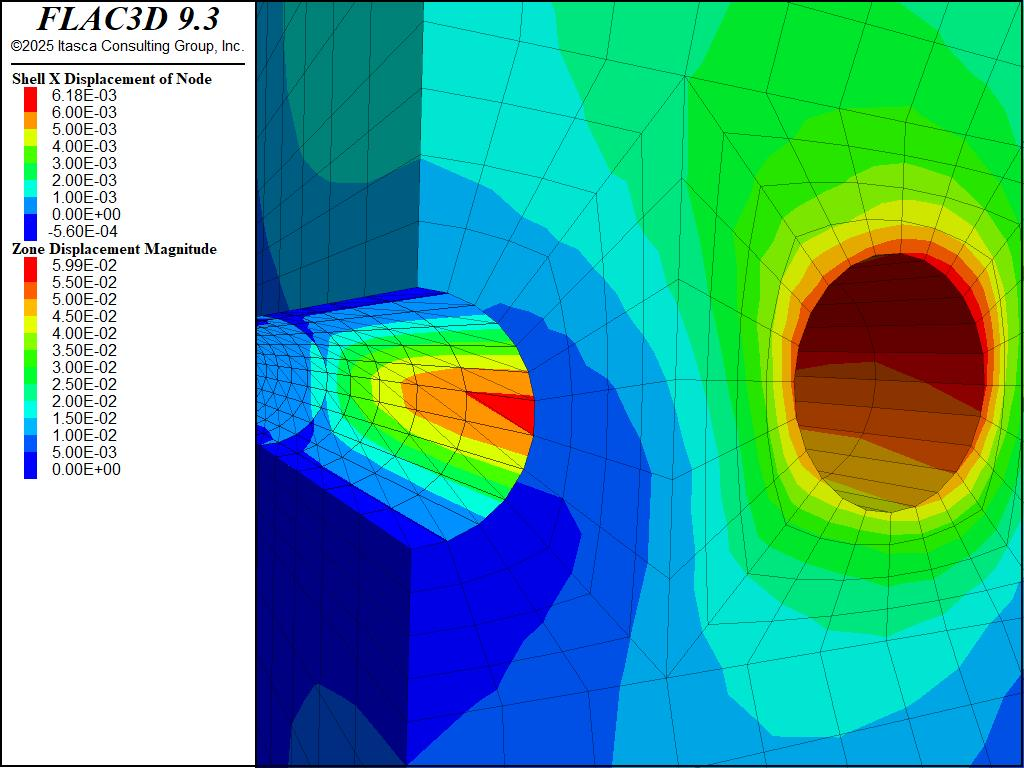
Itasca FLAC3D is the world’s leading continuum numerical modeling software for advanced 3D analysis of soil, rock, concrete, and structural support systems. Trusted by geotechnical, mining, civil, and energy engineers globally, FLAC3D delivers high-accuracy simulations for slope stability, underground excavations, tunneling, embankments, dams, seismic response, groundwater flow, and complex multiphysics problems.
What’s New in FLAC3D Version 9.7 – Key Functions & Highlights
Version 9.7 (build 9.7.50, released July 2026) introduces powerful new capabilities that significantly improve modeling efficiency, accuracy, and user experience:
- GeoBot Pro AI Assistant – Fully embedded AI assistant trained on official documentation, examples, training materials, and the Itasca forum. Ask technical questions in multiple languages, receive code snippets and links, and even generate and cloud-verify small example models (BETA feature). Dramatically accelerates learning and prototyping.
- More Robust Mohr-Coulomb Constitutive Models – Updated corner-domain stress corrections for all Mohr-Coulomb-based models (including Ubiquitous-Joint). Provides more accurate and stable behavior near the shear-tensile failure intersection, reducing numerical issues in complex rock and soil simulations.
- Advanced Sketch Tool Enhancements – Interactively split extrusions by adding and adjusting points along the path. Create complex curved extrusions faster and more intuitively without workarounds.
- MPI Zone Nulling During Cycling – With the Cluster option, zones can now be nulled while the model is solving. Enables highly flexible staged excavation and material removal workflows on large distributed models.
- STL Plot Export – Export plots as STL files (in addition to DXF) for seamless transfer to 3D printing, visualization, or external CAD tools.
- Improved Workflow Tools – Python variables and functions now visible in the Object Tree, anonymous command logging for better future development prioritization, and enhanced overall usability.
These additions build on the major advances of the Version 9 platform: 2–3× faster static and dynamic solving, Maxwell damping (up to 10–200× faster dynamic analyses), automatic domain generation, advanced structural concrete modeling, powerful FISH and Python scripting, and a modern, flexible user interface.